Showing posts with label UCNH. Show all posts

Sunday, January 5, 2020

Haiti Hiatus 2019


My usual return to Haiti to teach during the 2019 fall semester was canceled due to the protests that disrupted life not only in Port au Prince, but across the country. Even rural areas were affected as supplies couldn’t leave PauP and gas prices increased. Schools and universities ended up closing since students and teachers could not travel the roads Author Amy Wilentz wrote a synopsis of what led to the escalated protests and lock-up of the country: https://www.thenation.com/article/haiti-protests-petrocaribe/ Miami Herald also gives regular updates. At UCNH, classes resumed late Nov./Dec. as intensive courses, and exams will take place this month (January 2020). Si Bondye vle things will stay calm and schools will resume this year.

Here's a couple paragraphs from the Wilentz article (24 Oct. 2019) in The Nation:
Gas shortages related to the government’s inability to pay for shipments have plagued the country since the end of PetroCaribe, and continue today. When there is no gas, hospitals can’t provide medical care, bodies can’t get transported for burial and morgues begin to stink, transit stops, markets languish, schools shut, all industry collapses, and the gas-fueled generators that small businesses and better-off homeowners use for electricity during the long daily power outages shut down.

Meanwhile, in less than a year, the gourde, Haiti’s national currency, has lost a third of its value, with inflation up 20 percent. Thanks to runaway inflation, the little Haitians do manage to scrape together is now worth half of what it was worth four years ago. The price of chicken has doubled over the past few years, a liter of milk can cost as much as half the daily $2.50 minimum wage—which most people don’t even make because they operate in the “parallel” economy where the minimum wage is often $0. The annual per capita income is about $350 in the countryside and $410 in the city, and the price of a cup of rice, the national staple, has been rising by about 10 percent every 10 months. Meanwhile, families have already paid their school fees this year, but because of the protests and the lack of gas, they haven’t been able to send their kids to school. In a world without fuel and without jobs, there’s nothing to do. Except protest. Each week, the protests grow. They’re organized, too. One important group organizing marches in Haiti and in the Haitian diaspora is, fittingly, called Nou pap domi, or We Will Not Sleep.

(See Haiti Hiatus Part 2 for the 2020 COVID19 interruption!)

Sunday, June 16, 2019

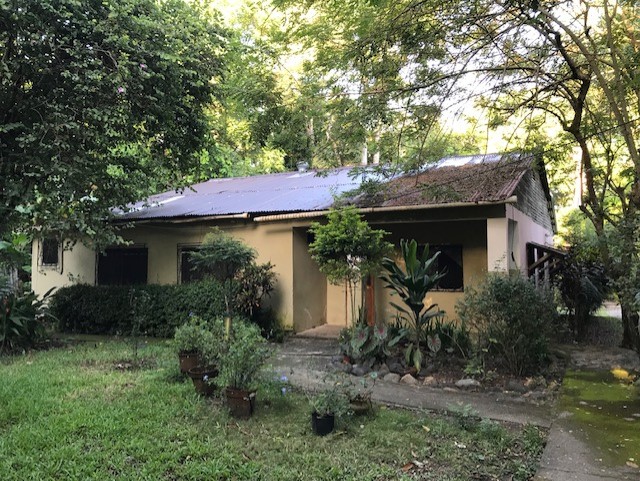
UCNH guest house


UCNH has a guest house for visiting professors and other people working with the university. I lived in the house for 5 months and saw many groups come and go with expectations that didn’t match the reality of the accommodations. It’s a great place to stay and your visit will be more enjoyable if you know what to expect. This is about the ranch house near the provost’s and president’s houses.

The house has 2 guest bedrooms with 2-3 single beds per room, 1 shared bathroom with indoor plumbing & flush toilet, kitchen with propane stove and refrigerator/freezer, dining room, and living room. Electricity is provided by a campus generator that runs approximately 7a – 11p most days. Rooms have ceiling fans (which won’t run once the generators turn off for the night). If you need electricity for a CPAP or other necessity, make sure your host knows before your visit to allow time for other arrangements. No internet – ask your host to provide a temporary hotspot.

The campus generator runs the water pump for the entire campus. No generator means no water, so prepare accordingly – take showers when generators are on. Keep bathroom buckets full of water, always! It takes not having water only once to remind you to keep them full. There is usually no hot water in the shower.

Don’t use the tap water for drinking or brushing your teeth. Drinking water comes from a biosand filter that is filled from the taps. It is safe – and avoids using individual plastic water bottles that just add to Haiti’s trash problem. Use the provided water filtration supplies, keep them clean, and make sure the blue jugs are kept full. Running low with no electricity to fill the filter is a quick lesson about being vigilant to keep the jugs full. Don’t use this precious filtered water for anything but drinking. Dishes are cleaned with water straight from the tap, followed by a rinse in bleach water.

The kitchen stove is propane, which is supplied in tanks brought from a larger town. Conserve fuel and don’t use it to heat bathing water. We need to cook food more than we need to have hot water for bathing. If your hosts arrange it, cooks will provide your meals. You can also buy snacks at the snack shop or off the street outside the university gate.

Towels and sheets are provided, and you should be able to find a mosquito net to hang over your bed, bring your own to be certain (leave it behind to make room for souvenirs). Toilet paper is provided sparsely – remind the house manager (not me!) often and early! Bring everything else you will need: toiletries, snacks, sun screen, bug spray, reusable water bottle, coffee if you want it before the cooks arrive in the morning.

The house has a beautiful yard and a front porch to enjoy the flowers and birds. See my other posts for things to see and do on campus and in the community.
 

Wednesday, February 6, 2019

List of UCNH birds

45 species of birds seen on and around UCNH campus as of 24 Apr. 2019.
Helmeted Guineafowl
Plain Pigeon
Common Ground-Dove
White-winged Dove
Mourning Dove
Smooth-billed Ani
Hispaniolan Lizard-Cuckoo
Antillean Palm-Swift
Antillean Mango
Vervain Hummingbird
Cattle Egret
Green Heron
Glossy Ibis
Red-tailed Hawk
Broad-billed Tody
Antillean Piculet
Hispaniolan Woodpecker
American Kestrel
Hispaniolan Parakeet
Gray Kingbird
Stolid flycatcher
Loggerhead Kingbird
Black-whiskered Vireo
Palm Crow
White-necked Crow
swallow sp.
Northern Mockingbird
Palmchat
Black-crowned Palm-Tanager
Ovenbird
Louisiana Waterthrush
Northern Waterthrush
Black-and-white Warbler
Common Yellowthroat
American Redstart
Cape May Warbler
Northern Parula
Black-throated Blue Warbler
Yellow-throated Warbler
Bananaquit
Yellow-faced Grassquit
Greater Antillean Bullfinch
House Sparrow
Village Weaver
Scaly-breasted Munia

Agroforestry tours at UCNH Haut Limbe


Criollo
In addition to the many species of birds found at and around Université Chrétienne du Nord d'Haïti (UCNH) in Haut Limbe (east of Limbe), visitors can learn about the agriculture in the area, including cacao - the source of chocolate, and bananas and plantains. There are many groves of each in the area, and the denser cacao groves host many species of birds, including: common yellowthroat, yellow-throated, black-throated blue, and Cape May warblers during the winter; broad-billed todys, Hispaniolan lizard-cuckoos and Antillean bullfinches, and the endangered plain pigeon. 


Chocolate is made from cacao seeds which are found in pods that grow directly on the trunks and branches of the cacao tree (a habit known as cauliflory which is common among tropical trees). All three varieties can be seen, even in the same grove. Criollo, supposed to make the best quality of chocolate, but susceptible to disease, is identified by reddish podsForastero, more productive but not as flavorful, is identified by longer grooved pods. The hybrid of these, Trinitario, combines these two qualities, and is identifies by its stouter warty pods.

You will also learn to identify the differences between plantain plants, which are starchy and boiled or fried, and the sweeter banana plants. Plantain leaves are a lighter green and have a pink edge, and the bunches are looser. They grow better in the sun. Banana leaves are slightly darker, have a thinner browner edge, and the bunches are tighter.

Contact me if you would like a tour to see birds, agriculture, or chocolate making. Please be considerate and ask your guide before taking photos of people.

Yellow-throated warbler
Trinitario the hybrid

Forestero


Banana
Plantain


Banana left, plantain right with pinker wider edging

Saturday, January 26, 2019

Birding along the Bay of Acul

The gravel beach at the end of the road
If you want to see shore birds and waders, including glossy ibis and black-necked stilts, travel the road that runs along the west side of the Bay of Acul. It leaves National Rt. 1 less than 2 miles from UCNH in Haut Limbe as you head toward Cap Haitien, or about 9 miles west of Cap Haitien. The road ends at a gravel beach that has restaurant stalls. We were there early in the morning so didn’t get to see how many people come to use the beach, or how many food stalls operate. The only birds were English House Sparrows and a passing Great Egret and Cattle Egret.

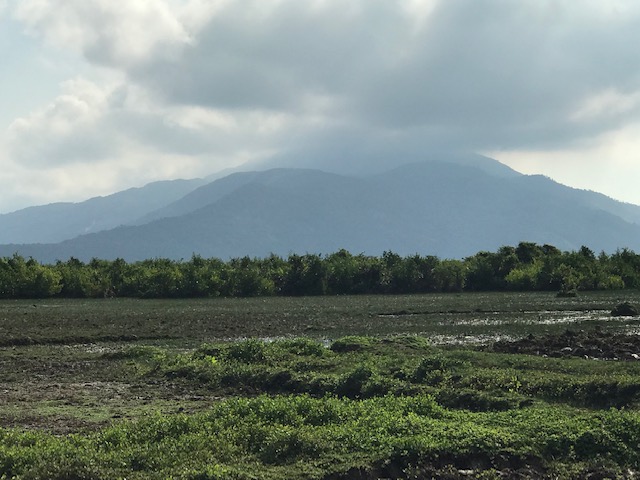
The hub of bird activity is in the rice fields along the bay. Stop along the road and follow a path towards the bay. You should have a Haitien friend escort you into the fields, to ask permission to pass and explain to the local people why you are there. We drew a little crowd. We saw many glossy ibis, killdeer, lesser yellow legs, and cattle egrets. We also saw 13 bird species on the walk along the road between St. Louis and St. Michel, including a grassquit and 2 red-tailed hawks. If you enter your birds into eBird, be sure to mark the shore and rice field/mangrove survey as part of the Caribbean Waterbird Census (CWC)!

Rice fields and mangroves - there are many birds out there!


Walking the road between St. Louis and St. Michel


Thursday, December 13, 2018

UCNH - birding and academic hotspot!


Hispaniolan parakeet - endemic, threatened
One hour west of Cap Haitien, off of Rt 1, sits a university whose founders and subsequent presidents prohibited cutting of trees (directions here). Today Université Chrétienne du Nord d'Haïti (UCNH) and the surrounding area of Haut Limbe is home to over 30 species of birds, and is a relaxing place to enjoy large trees full of lianas, bromeliads, and other life you’d expect to see in a tropical forest. Parakeets fly by every day and sometimes hang out on campus, warblers make it their winter home, and woodpeckers, palmchats, red-tailed hawks, and banaquits raise their families here. If you are up for a hike, there are great views from the surrounding hills and you might see a loggerhead kingbird, merlin, or plain pigeon. See here for list of birds.

UCNH also has a snack shop, copy center, bookstore (academic books in French), and library. Agronomy students have a plant nursery on campus, and you can visit a cacao grove and learn about chocolate. Perhaps while visiting you’ll get to see a performance by the fine arts students. Contact me if you’d like to set up a tour and a budding ecotourism student can show you around and take you birding, or to see cacao and plantain/banana groves.

Red-tailed hawk on campus

Plain pigeon - endemic, threatened

White-necked crow - endemic, threatened

Louisiana waterthrush
Hispaniolan lizard-cuckoo - endemic