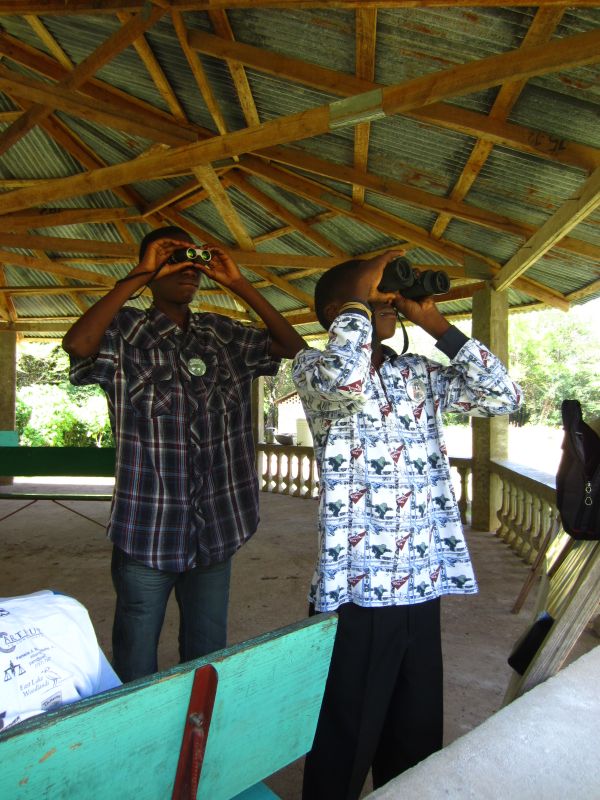
 If you would like to book an ecotour while visiting the Pignon and Hinche areas, call guide Louiders at 509-3881-2985 (current Nov. 2016) or email me (Debbie) at naturesphoto@hotmail.com and I will contact Louiders (in the photo). Contact me two weeks in advance to allow ample time for getting in contact with the guide (internet and electricity can be unstable in Haiti!). Until the internet is more common and accessible, this blog serves as the website for Louiders, and will be updated as needed.
The Central Plateau: Haiti’s Central Plateau lies between two mountain ranges, the Massif du Nord (600-1100 m, 2000-3600 ft high) and the Montagnes Noires (600 m high). Though it has become largely deforested, this region provides visitors many opportunities to enjoy Haiti’s bird life and culture.
Bird Tour: Over 230 bird species live on the island of Hispaniola, including 31 that are endemic (found no where else in the world). This bird tour gives you an opportunity to see many of these species while following the footpaths that bisect the region. Your guide will have one set of binoculars for your group to share, plus a bird book. Click here for birds you may see.
Cultural Tour: Sugar cane and coffee were once major exports of Haiti, and still provide a living for people in this region. On this tour you will learn about the sugar cane industry, from stalk to finished products. You might also get to visit a working press if one is in use during your tour. Coffee is the number two world commodity after oil. You will learn how coffee is grown, harvested, and turned in to the brew loved by many. You will also be able to purchase coffee directly from the roasters.
Rates: Foreigners - $20US per person for a 2-hour tour, $40US per person for a 4-hour tour. Reduced rates for groups and nationals are available. Tours are in English or Creole. Louiders will shape the tour to your needs! Specify whether you would like a private tour or don’t mind being with other visitors, or if you are a serious birder. --Tips are appreciated!--
There is a guest house next to the Pignon airstrip. Louiders will arrange to meet you in front of the university UCCC in Caiman (near Rt3) or at HAFF on Rt3 in Bohoc, and can arrange a ride for you if necessary.
What to bring: Sunscreen, sunglasses, comfortable walking shoes, binoculars if you have them, snacks if you need them, camera, water.
Tour etiquette: Your guide will let you know if you can take pictures of cultural activities. Ask permission before taking pictures of individuals. Respect private property, including livestock and dogs. Respect wildlife and be aware of how your activities affect plants and animals. Be conscientious about eating in public. Many people can afford only one meal a day.
Developed in 2009, this program promotes: Educational opportunities for Haitians and visitors, Sources of income for guides and cultural demonstrators, Development of business skills, Appreciation of our reliance on a healthy environment.




 If you would like to book an ecotour while visiting the Pignon and Hinche areas, call guide Louiders at 509-3881-2985 (current Nov. 2016) or email me (Debbie) at naturesphoto@hotmail.com and I will contact Louiders (in the photo). Contact me two weeks in advance to allow ample time for getting in contact with the guide (internet and electricity can be unstable in Haiti!). Until the internet is more common and accessible, this blog serves as the website for Louiders, and will be updated as needed.
