Monday, April 8, 2019

Chocolate making tour

Roasting cacao seeds
An ecology student showed me how chocolate is made, from picking the pods, to drying and roasting the beans, and grinding them into what we would call pure chocolate. Finally we made it into the hot chocolate drink people enjoy here. Everything took place within walking distance of UCNH university near Limbe. Let me know if you would like to set up a tour! See this blog for how to identify the 3 varieties.


Drying the cacao beans

Grinding the cacao beans
Resulting balls of cacao which are boiled to make hot chocolate.
Boiling the ground chocolate in water, before adding milk and sugar to make a drink.


Sunday, February 24, 2019

Casa Cubuy Puerto Rico

I took a week off from Haiti to attend a BirdsCaribbean shorebird workshop in Puerto Rico, and ended up staying an extra 4 days as political protests in Haiti grew and shut down the country. The stay included 2 nights at a really cool lodge called Casa Cubuy on the south side of the El Yunque National Forest. I didn’t have much time to research my extra stay in PR, and am glad I ended up here. The owners were kind enough to email and call me with directions. The narrow windy road up to the lodge is scenic. Follow the directions on the website, and look for the last yellow building on the right. There is parking on the downhill side of the lodge, but no sign with the name. When I arrived a bit frazzled from deciding to head back to the US instead of Haiti, the owner Michael invited me into the kitchen and offered me a glass of wine and sliced up a mango for me.

My room was spacious, with 3 beds, 2 little desks, a ceiling fan, and a bathroom with hot water. The balcony overlooked the forest and cascade that sits below the lodge, and had a little table and chairs. It was very relaxing to hear the coqui frogs and cascade at night. I brought food for my lunch and dinner as the closest place for meals was 20 minutes away (the town of Naguabo off Hwy 53 has gas, grocery store, and restaurants). The kitchen has a large refrigerator for guests to use. They will make lunches for guests for $10, either to take on a hike or eat at the hotel.

Breakfast isn't served until 9am, so I missed it the first morning as I hired a guide for birding. The 2nd morning I got to see what I missed out on – a family-style breakfast with the other guests, with lots of fruit, juice, and coffee, and wonderful oatmeal, eggs, and hash browns made by the owner.

Casa Cubuy is in the national forest and has a short path to the cascade below that has pools deep enough for swimming. The road past the lodge gave me a chance to do some birding, and I heard that at the end of the road are paths into the forest. Unfortunately my stay wasn’t long enough to explore those.

The only drawback to Casa Cubuy was the 40 minute drive back to the area that had beaches and more parks and tourist attractions (around Fajardo). A longer stay at the casa would have been ideal, with a couple day-trips to other attractions. Also I am an early morning person so waiting until 9am for breakfast was inconvenient, so worth a longer stay to have mornings to enjoy that.

Here are the birds I saw just from the road, with links to eBird. Also, I was told the guesthouse downhill has hummingbirds.


Wednesday, February 6, 2019

List of UCNH birds

45 species of birds seen on and around UCNH campus as of 24 Apr. 2019.
Helmeted Guineafowl
Plain Pigeon
Common Ground-Dove
White-winged Dove
Mourning Dove
Smooth-billed Ani
Hispaniolan Lizard-Cuckoo
Antillean Palm-Swift
Antillean Mango
Vervain Hummingbird
Cattle Egret
Green Heron
Glossy Ibis
Red-tailed Hawk
Broad-billed Tody
Antillean Piculet
Hispaniolan Woodpecker
American Kestrel
Hispaniolan Parakeet
Gray Kingbird
Stolid flycatcher
Loggerhead Kingbird
Black-whiskered Vireo
Palm Crow
White-necked Crow
swallow sp.
Northern Mockingbird
Palmchat
Black-crowned Palm-Tanager
Ovenbird
Louisiana Waterthrush
Northern Waterthrush
Black-and-white Warbler
Common Yellowthroat
American Redstart
Cape May Warbler
Northern Parula
Black-throated Blue Warbler
Yellow-throated Warbler
Bananaquit
Yellow-faced Grassquit
Greater Antillean Bullfinch
House Sparrow
Village Weaver
Scaly-breasted Munia

Agroforestry tours at UCNH Haut Limbe


Criollo
In addition to the many species of birds found at and around Université Chrétienne du Nord d'Haïti (UCNH) in Haut Limbe (east of Limbe), visitors can learn about the agriculture in the area, including cacao - the source of chocolate, and bananas and plantains. There are many groves of each in the area, and the denser cacao groves host many species of birds, including: common yellowthroat, yellow-throated, black-throated blue, and Cape May warblers during the winter; broad-billed todys, Hispaniolan lizard-cuckoos and Antillean bullfinches, and the endangered plain pigeon. 


Chocolate is made from cacao seeds which are found in pods that grow directly on the trunks and branches of the cacao tree (a habit known as cauliflory which is common among tropical trees). All three varieties can be seen, even in the same grove. Criollo, supposed to make the best quality of chocolate, but susceptible to disease, is identified by reddish podsForastero, more productive but not as flavorful, is identified by longer grooved pods. The hybrid of these, Trinitario, combines these two qualities, and is identifies by its stouter warty pods.

You will also learn to identify the differences between plantain plants, which are starchy and boiled or fried, and the sweeter banana plants. Plantain leaves are a lighter green and have a pink edge, and the bunches are looser. They grow better in the sun. Banana leaves are slightly darker, have a thinner browner edge, and the bunches are tighter.

Contact me if you would like a tour to see birds, agriculture, or chocolate making. Please be considerate and ask your guide before taking photos of people.

Yellow-throated warbler
Trinitario the hybrid

Forestero


Banana
Plantain


Banana left, plantain right with pinker wider edging

Monday, January 28, 2019

Hotel Rival, Cap Haitien

Steps to the beach are to the right of the gate.
I learned about Hotel Rival from Paul Clammer’s Bradt Haiti guide. I wanted to go to Fort Picolet so stayed in the hotel closest so I could walk. It is a clean hotel with a great view of the ocean and a nice pool. The bar area has nice ocean view seating. Ask for room #2 to get a large corner room with 2 balconies. The property, tucked into the hillside, shares a gated road with houses, so you have a quiet road to walk and see birds. The road to get to the hotel is a bit rough, but passes a small fort (Etienne-Magny) that I didn’t notice was a fort until I passed it later on a moto and saw the canons. The Crammer guide mentions a second fort that might have been what formed the wall along the road at the hotel gate.

It was odd that I seemed to be the only guest, and the staff weren’t at the front desk much, mostly saw them hanging out upstairs near the bar looking at their phones. I ordered a drink, they couldn’t make change for my $20US bill, so I gave them my remaining small bills and didn’t have any left for a tip. The room didn’t have electricity part of the time. The bathroom didn’t have amenities except towels and a bar of soap. I forgot to see if the shower had hot water since I’m not used to having any! According to the Crammer guide there is a restaurant, which must have been the bar area, but there was no indication they served food until I went up the next morning for the complimentary breakfast which was really good - an omelet, bread, butter, jelly, juice and coffee. Someone else was eating there so I must not have been the only guest.

Don't get excited about swimming at the beach. You can access it from stairs outside the hotel gate (the start of the route to Fort Picolet), but is a bit trashy (including a syringe - don't go barefoot, but I've seen worse). Knowing what runs off into the bay from Cap made me leery of going in the water. Plus people literally bathing there, and groups of men standing around watching, made me uncomfortable about being the only foreigner.

I am a low key traveler with electricity only part of the time at home, so the sparseness and partial no electricity was ok with me, but if you expect the amenities of the Roi Christophe or Mont Joli you might be disappointed. It is not within walking distance of anything except the forts. That and the ocean view was the only thing that made it worth $100 for one night. I think if they charged $70/night they'd have more guests, and thus could improve the service! So enjoy Hotel Rival for the view, pool, and access to forts!

Yummy breakfast and great view!

All rooms seem to face the ocean.

Nice pool!

Large room!

One of the balconies on room #2.


Sunday, January 27, 2019

Fort Picolet, Cap Haitien

Thanks to Paul Clammer’s Bradt Haiti guide, I learned about Fort Picolet and stayed in the nearby Hotel Rival to go on an early morning hike to explore the fort. The 'path' to the fort starts outside the gate to the hotel, go down the stairs to the beach. And keep following the shore at the base of the hill. Wear sturdy shoes that you can get wet (there's medical and other trash on the beach - don't go barefooted). We departed about an hour before high tide and didn’t have to walk through water, but have heard that at high tide water might be up to your knees.

Clammer describes the walk as involving 'a bit of scrambling' which must be British for you need to walk over loose rocks of all sizes and hang onto your surefooted friend to get up and down the big rocks and steps along the shore. See the photos for how high you need to scramble. Would be difficult for someone with bad knees or unsteady in walking.

Once at the fort just climb the stairs and explore! The guide book says this is a French fort built around 1740. There are still canons there. Be sure to go up the little set of stairs on the wall they sit along, and down the other side, and you'll get a good view the waves crashing into the rocks below. On the other side of the fort is a metal structure that must have been a light house.

We started the hike at 6:30a and were back at the hotel at 8am. There are paths to follow if you want to explore more of the hillside. There was no one at the fort, and no one along the way harassed us. There are signs of recent Vodou practice at the fort, even a peristyle, and people were praying with candles at a huge rock that is on the way to the fort.

It is well worth the walk! And look for the cool crabs and snails on the way.

The view from the start of the walk near Hotel Rival

Climb up and over the rocks!
A big step up!
The steps from the beach up to the fort.
At the fort, looking back at Hotel Rival
The peristyle
A lighthouse?

Saturday, January 26, 2019

Birding along the Bay of Acul

The gravel beach at the end of the road
If you want to see shore birds and waders, including glossy ibis and black-necked stilts, travel the road that runs along the west side of the Bay of Acul. It leaves National Rt. 1 less than 2 miles from UCNH in Haut Limbe as you head toward Cap Haitien, or about 9 miles west of Cap Haitien. The road ends at a gravel beach that has restaurant stalls. We were there early in the morning so didn’t get to see how many people come to use the beach, or how many food stalls operate. The only birds were English House Sparrows and a passing Great Egret and Cattle Egret.

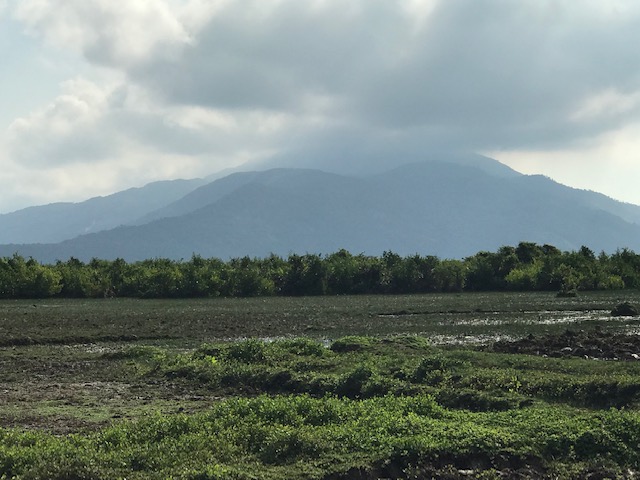
The hub of bird activity is in the rice fields along the bay. Stop along the road and follow a path towards the bay. You should have a Haitien friend escort you into the fields, to ask permission to pass and explain to the local people why you are there. We drew a little crowd. We saw many glossy ibis, killdeer, lesser yellow legs, and cattle egrets. We also saw 13 bird species on the walk along the road between St. Louis and St. Michel, including a grassquit and 2 red-tailed hawks. If you enter your birds into eBird, be sure to mark the shore and rice field/mangrove survey as part of the Caribbean Waterbird Census (CWC)!

Rice fields and mangroves - there are many birds out there!


Walking the road between St. Louis and St. Michel