Showing posts with label waterfalls. Show all posts

Monday, February 6, 2017

Bassin Zim 2017

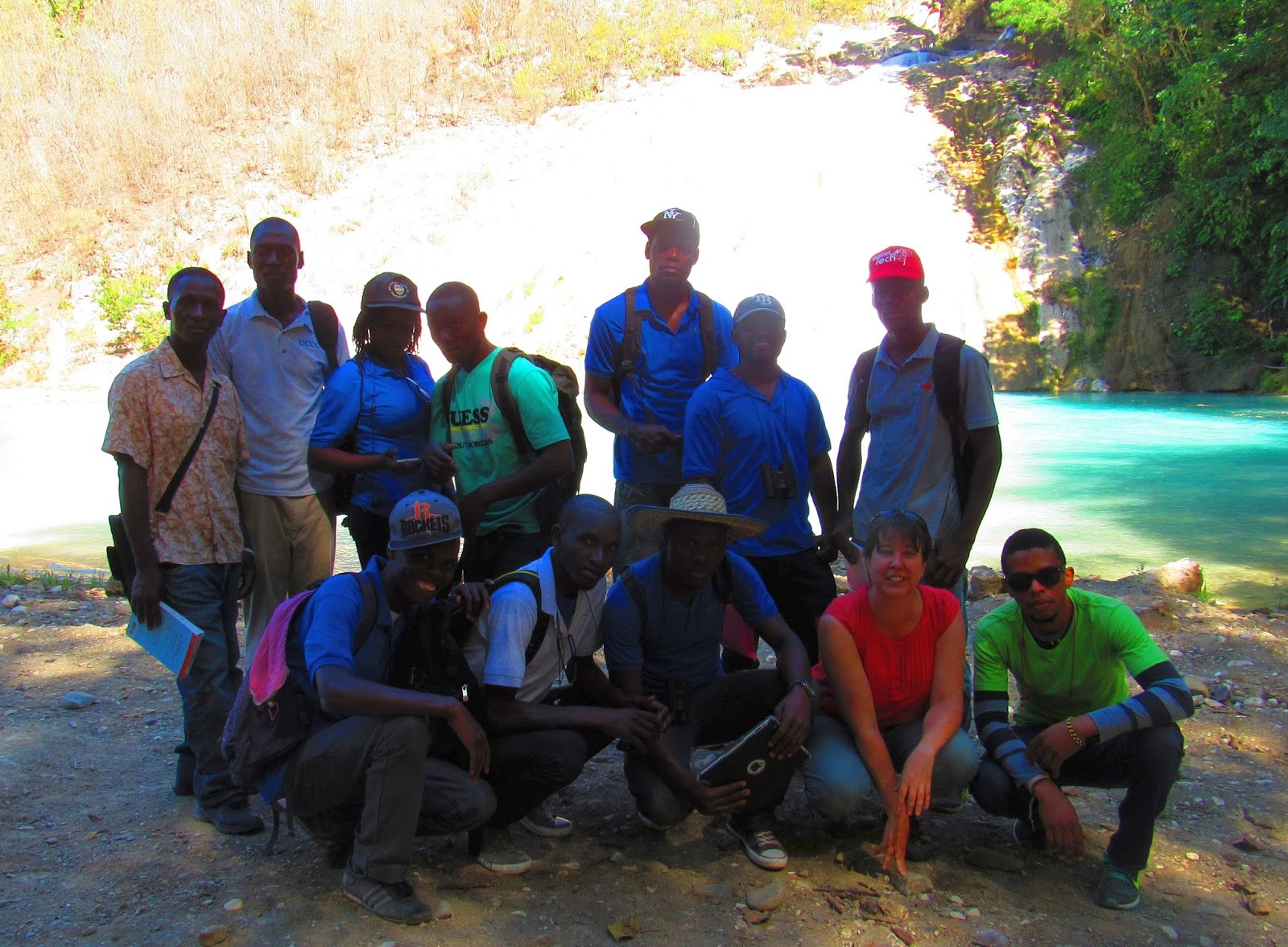
This month I took my ecology 201 class (freshmen) on its annual trip to Bassin Zim near Hinche.  Classes are getting larger each year, so we had to divide the group up between two Saturdays.  There is now a sign at Bassin Zim with entrance fees, so we didn’t have the usual dramatic haggle of price negotiation.  Maybe someone saw last year’s blog post complaining about that?  The fee is $5 for foreigners, and 50 gds (78 cents) for Haitians, and they give us a reduce price!  The goal of the trip was for students to experience performing a bioassessment of the site, comparing the basin below the falls (where people swim, wash, etc.) to the small stream that comes out of the cave above the falls.  There is a remnant of a forest along this river – perhaps because of the spiritual taboo of cutting trees around cave entrances.  

We looked at land use, tested water quality (bacteria, nitrate, phosphate, pH, DO), and used sPer environmental meters* to measure air temp, humidity, light, and wind.  No one killed anything this time, and students picked up their liter.  I tried to give the young ‘guides’ (kids who live near the park and grab your hand to ‘help’ you, hoping for a tip) some suggestions for protecting the park, like use the paved paths.  See the Audubon Center blog for comparison of results over the years.

*Thanks to the 2016 Amazon Workshop for introducing me to these meters and guiding us through activities in how to engage students in environmental science.  Click here to sign up for their workshop in the Peruvian Amazon.


Monday, January 25, 2016

Bassin Zim guards and guides

Entrance to Bassin Zim
Feb. 2017 update - they addressed these complaints!  There is now a sign with prices and we entered the park in peace.

Bassin Zim is a waterfall near Hinche in the central plateau.  HaitiLibre had an article about the Ministry of Tourism putting it on their "Water Route" circuit so it will “be part of a model of sustainable development based on community tourism.”  The Ministry met with the locals in Dec. 2015 to discuss “the need for communities to well welcome visitors to the site.”  I write this review to give the Ministry some feedback from a foreigner’s point of view. 

Three times I have taken my Haitian university students to Bassin Zim to learn about water quality, and have not felt welcomed upon arrival.  The 15 minute haggle over entrance fees makes for a poor start to the visit.  It is especially sad that the guards want to charge their fellow Haitians twice as much just because a foreigner is with them.  Negotiations involve telling the guards we were charged 25 gds per person on our first visit, the guards insisting on 50 gds a person then getting mad and yelling.  One time this deteriorated into them hitting children with sticks and large rocks, making the kids cry.  While the kids had disrespectfully yelled at the guards to let us in, the violent reproach left a very bad impression.  

Last week my freshman ecology class negotiated a price of 250 gds ($4) for the entire van of 19 people.  As we left we thanked the guards and said we’d return with another class.  Yet on arrival just one week later with my juniors, the same guards again demanded 50 gds a person.  After much haggling and the guard feigning locking gate and stomping off, my junior ecology students managed to get us in for 250 gds, this time for a van of 13.  Each time my students were respectful, and even broke up the fight between the guards and the children.

Measuring turbidity.
During last week’s visit with my freshmen, five “guides” (both children and adults) followed us around and insisted on “helping” me (but not my students), even though my students explained we had a plan and knew where we were going.  This week the children figured out we had an agenda and hung out in the background.  A student gave them a little lesson about testing water chemistry and evaluating the watershed.  If the Ministry of Tourism really wants to promote Bassin Zim, it needs to standardize and post entrance fees (with reduced rates for locals), and train guards and guides to be courteous to visitors (both Haitian and foreign). 

If they truly care about the water and sustainability, they need pick up trash, ban livestock and washing in the river, protect the remaining trees (charcoal was being made right along the path to the cave), put a buffer of more trees around the park (crops grow right up to the walkway), and remove the new tilapia pond that sits next to the cave and dumps directly into the river.  Maybe someday one of my students will work for the Ministry of Tourism or the Environment and enact these changes.


The big cave

Small cave
Teaching about water quality next to the tilapia pond.

Measuring temperature.
Measuring forest density.


Sunday, November 23, 2014

Bassin Zim Haiti

I took my ecology class on a field trip to Bassin Zim in Haiti’s Central Plateau.  The road to it is in Hinche off of National Route #3.  At the last big bridge as you are heading out of town toward Pignon, on the Pignon side of the bridge look for the road that goes to the east (marked 308 in google earth).  Take this road until you come to a fork with a large sign for a peasant organization, it has the word LAKAY on it.  Take the road to the left and keep going through Papaye.  You’ll eventually see a green sign for the falls, and the road gets rocky and steeper going downhill, until it ends at the parking lot for Bassin Zim.  It might be ½ hour from the highway, but we kept making stops so I lost track (see this post for the stops).  You can see the basin in aerial maps, in google earth search Bassin Zim, Centre, Haiti.

We paid 25 goudes each to enter, and as soon as we started walking a bunch of kids came and 2 latched on to me as my guides (even though I was with 12 university students).  They helped me on some of the rockier parts of the trail and across the stream up to the cave.  I gave them each $1US at the end.

The basin at the base of the falls isn't ideal for swimming since the force of the water creates a whirlpool with debris swirling in it.  Downstream where it becomes a stream might have been ok, but there were women washing clothes at the edge of the pool.  A bunch of UN soldiers from Uruguay were having a party there and had inflatable tubes, so they must have been swimming.

The walk up to the cave is relatively easy, up steps and across a small stream.  Wear shoes you can get wet.  At the first landing you can see the basin from above and several pools leading down to it.  There is also a small alcove with stalagmites and stalactites and what looks like voudou activity.  Get back on the steps and keep going up to the main cave.  There the small stream starts from a pool that has little fish.  There are wasp nests all over the wall of the cave, as well as swallow nests.  Shine a flashlight into the cavern that is farther in and you’ll see bats.  We didn’t climb up into the cavern, so I don’t know where it leads.  The child guides knew where to spot boas in the trees.

I would like to visit Bassin Zim again with fewer people, no “guides,” and spend some time birding and exploring the streams!


Saturday, January 25, 2014

Ecotour Day 3 – Saut Mathurine at Camp Perrin

The blue pool at the base of the non-falling falls.

On our third day of the ecotour we drove to the waterfall Saut Mathurine at Camp Perrin.  Our purpose was to enjoy the falls, walk along the river, and see what the vegetation was like for birding.  Unfortunately the falls have been completely diverted the past year for hydroelectricity!  Not even a minimal flow is falling.  They are doing a great disservice to the tourism industry by shutting off the beautiful falls.  This would be a great place to start the day early with birding (the gray-crowned palm tanager was there), followed by a swim in the pool at the base of the falls (which is cold!), and then lunch at the new restaurant just up the hill.  Bring snorkeling gear to see the friendly fish that gather around the rocks (only saw one species). 

The woman at the gate to the falls said we couldn’t drive the truck down, but we paid her $10 and she let us drive through.  Don’t go all the way down to the end of the road, the rocks are slippery and while not steep, we had trouble turning around.  Park just beyond the restaurant and art shack.  A series of easy steps lead down to the fall, then you can cross the river to go birding in the wooded area.  The hillside above the river is pretty steep and slippery – wear good hiking shoes.  You can also go above the falls which is worth the view.  The path right along the falls is very rocky, steep, and very very slippery.  There is a dirt path up through the wooded area farther to the right of the falls.  

The new restaurant along that road has typical Haitian food – fried meats and starchy foods.  It is made to order, so be prepared to wait and enjoy the view of the falls and trees.  We ended the day with a drive on a steep road to the source of the water.  In our non 4wd truck we made it, but wouldn’t be able to if the road was wet.  This would also be a great place to get to early and go birding and exploring.  The hydroelectric dam is farther downstream near the falls which is worth a visit to see the river and for those interested in hydroelectricity.

Access – Easy walk down the steps to the falls.  Difficult hike to top of falls.  Flattish land along the river.

From the top of the falls.  The algae-covered rocks are very very slick.

The river downstream of the falls.

The steps leading down to the pool.

The source of the river, which is now diverted to the hydroelectric plant.