Showing posts with label teaching. Show all posts

Wednesday, November 8, 2017

Bird lessons at the new UCC preschool

PSI
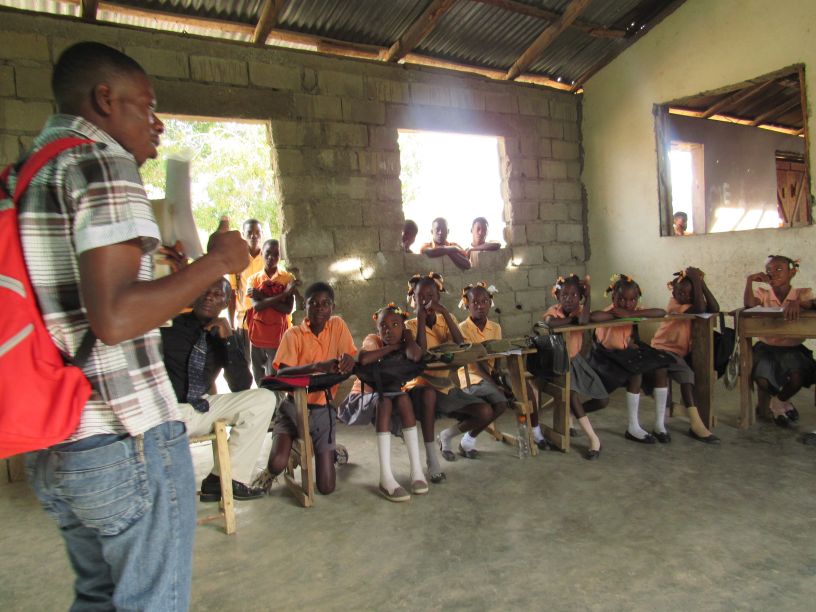
UCC in Caiman opened a preschool in Bohoc by the market, so the little kids don’t have to walk so far.  I took me 35 minutes to walk to this school from Caiman.  My translator Louiders and I had a 15 minute program for each class, PSI, PSII, and PSIII.  We taught the parts of the birds by having kids act them out, pretending they had beaks, wings, and tails.  As the kids age additional grades will be added to the school.

PSII

PSIII


Monday, January 23, 2017

Hawk, baby, mouse

The day my translator was not available to help me teach at the elementary school, I had to improvise based on what little Creole I am able to speak, and came up with this game to teach kids that hawks eat mice.  I had kids take on the roles of mama hawk, baby hawk, and mouse.  The baby asks the mother for a mouse, and the mother chases the mouse and gives it to the baby who says “Mesi manman!”  Even the preschoolers could do it!


Thursday, August 11, 2016

Educator Academy Part 2 - ExplorNapo Lodge

This post continues the previous, leaving Iquitos Peru on a boat ride up the Amazon River and arriving at the ExplorNapo Lodge.  Our first night at ExplorNapo consisted of orientation to the lodge and Educator Academy program, introductions, dinner, and a night boat ride.  I opted out of the boat ride so I could get up bright and early at 5:30am the next day for the first of many morning birding excursions by boat.  With very knowledgeable guides Luis and Lucio, and returning birders Phil and Dave, we saw over 150 bird species in just 8 mornings of birding (1.5 hours each).  And also saw the pink Amazon River dolphins!  And sloths!  Each night we took either a boat ride or forest walk to see caiman, sleeping hummingbirds, bats, bioluminescent fungi, and the Southern Cross (for the first time). 

Our days were packed with lessons and discussions about the forest and hands-on activities.  This gave me many ideas of what I can do with both the Haitian university and elementary students, such as having students interpret tables to make graphs of biodiversity, explore one-meter square areas of forest floor, and look for birds with Cornell’s BirdSleuth kits (if anyone would like to help me purchase supplies, you can donate at my Global Scholars account).


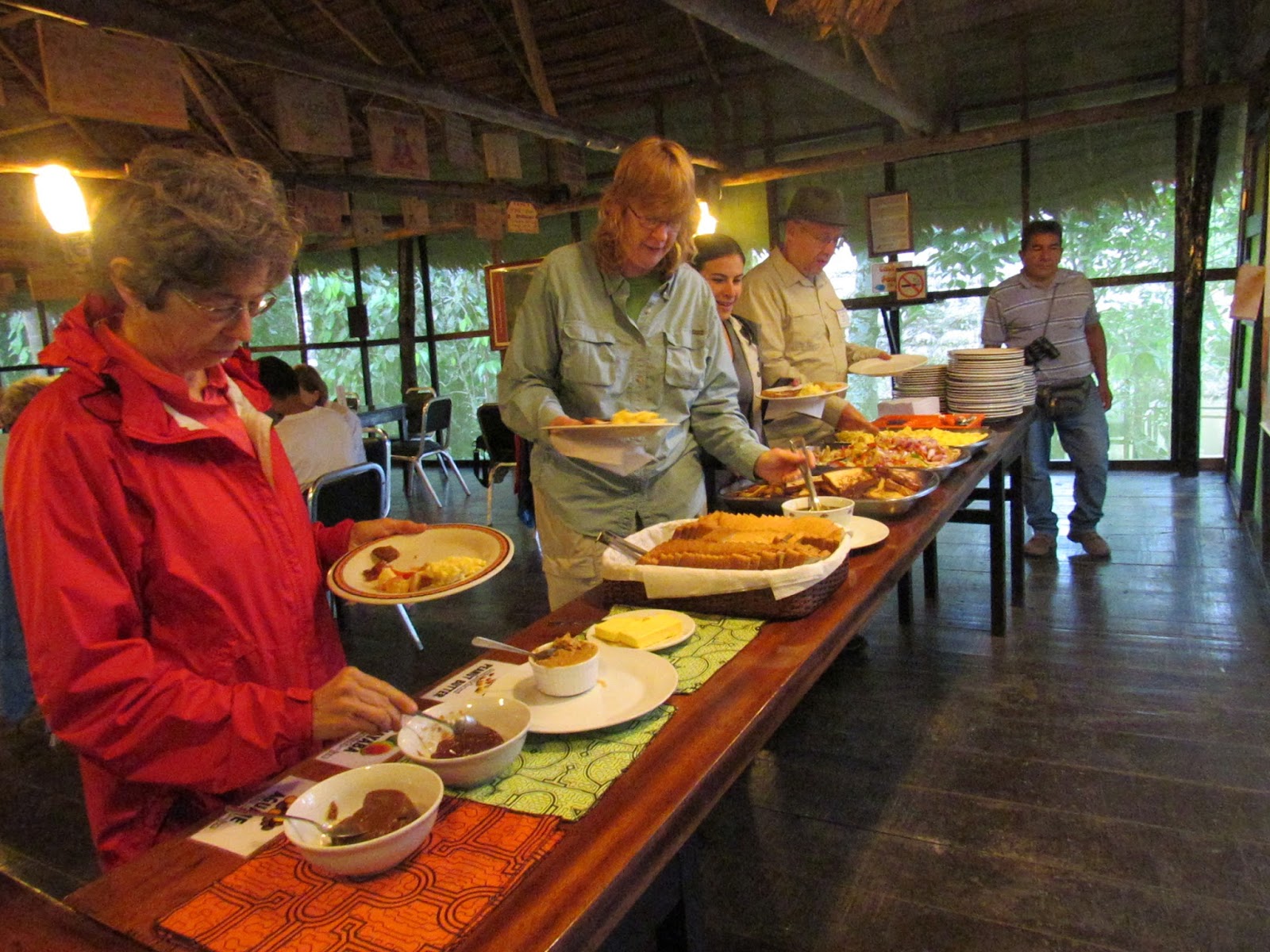
The Explorama series of lodges are very well maintained and serve great food.  All have large dining halls where we had our classes (with water, coffee, and tea available all the time).  These first three nights we stayed at ExplorNapo Lodge.  To reach our dorms from the dock and dining hall we had to cross a bridge over the flooded forest!  Talk about immersion into your studies.  While there was electricity in the dining hall, kerosene lanterns lit the bedrooms and walkways.  The latrines were huge!  And showers cold, so I adopted my Haiti routine of showering and laying out my evening things during the afternoon while there was light and a cold shower felt good.  We were in the Amazon during Peru’s dry winter season, so temperatures stayed around 75F.  Which meant I used a blanket at night.  But humidity was so high that you work up quite a drenching sweat just walking through the forest during the day.  Many visitors staying at the more upscale CeibaTops Lodge (electricity and hot showers) stopped at ExplorNapo for lunch on their way to the ACTS Canopy Walk – subject of the next post!

Breakfast!!
Giant latrine!  With nice walls.
Walkway in front of the rooms.
Mosquito nets over the beds.  Open windows and thatched roof!


Saturday, August 6, 2016

Tropical Ecology Class for Teachers – Educator Academy Part 1

Flight to Iquitos over Amazon forest & rivers.
I teach tropical ecology classes at UCCC in Haiti, and was fortunate to take a tropical ecology class of my own this summer!  In the Amazon!  I wanted to see in person what it is that I teach my class: the physical structure of the rain forest, the shallow organic layer covering the forest floor, the diversity of birds and other wildlife.  However, to reach Haiti’s remnant tropical forests such as those at Peak Macaya requires a day and a half drive, a day’s walk, camping equipment, hiring a guide, etc.  It all seems complicated.  And financially impossible to take my students.  Then I learned about the Educator Academy in the Amazon Rainforest that takes teachers from the US to Peru to not only teach basic tropical ecology, but just as importantly, how to convey that information to students.  And I received a partial scholarship to attend the academy!  

Charcoal in Iquitos (like in Haiti)
The following posts highlight the activities we did at each of the ExploramaLodges that we stayed in during this 10 day excursion.  The lodges are located along the Amazon River and its Napo tributary, accessible only by boat from Iquitos, Peru’s port city on the Amazon (and the largest city in the world accessible only by boat or plane).  Who knew that the Amazon River had ports as large as ocean-side ports?  And that ships travel all the way upstream 2200 miles from the Atlantic Ocean? 


The trip consisted of flying to Lima Peru, meeting up with 30 other teachers and the academy faculty, staying overnight in a hotel connected to the airport, flying to Iquitos on a rather large plane, and landing in a decent-sized regional airport (I was expecting dinky plane and airport like in Haiti).  We loaded onto a bus and stopped at a market on the way to the boat dock.  I couldn’t help comparing everything I saw to Haiti, which made me realize I expected Peru to be less developed, and perhaps indicates how undeveloped (or just chaotic) Haiti really is (the crowds, litter, downed electric lines, open manholes, horrible traffic, etc. has all become normal to me). 

Cat at the Iquitos market
At the dock we boarded two boats for a 2 ½ hour ride ON THE AMAZON RIVER!  To our first lodge – located IN THE AMAZON FOREST!  More to come in the next post.

Tapir and caiman skulls?  

Logging ship on the Amazon River.
Large ships at port on the Amazon River.


Monday, December 7, 2015

Birding with the cave children

Antillean Mango posing for the kids.
Last year I taught in a small village that sits away from any roads and is a 20 minute walk from my house.  I don’t know if any foreigners pass through except to go to a nearby cave.  I forget how we fell into teaching in the yard of Goyo, the man who owns the cave (JeanJean always mentions that he owns some of the cave too!), but last year Louiders and I went to his house weekly to give one hour-long ecology lessons to the kids.  We recently began lessons again, and I decided to do something that seemed likely to be chaotic – take the random assortment of 30 kids, aged 2 to 18(?) years old, birding!  We had been taking the orderly elementary school classes at UCC out birding, so had some practice (see this post).  Birding at three in the afternoon also seemed risky, but we tried it anyway with great success.  The children shared the seven binoculars (thanks to everyone who donated them!).  We didn’t see many birds, but a hummingbird hung out with us long enough for us to see its curved beak indicating it was an Antillean mango, and black stripe indicating it was an immature male.  These pictures show the kids having fun!
Showing the little one how to use binoculars. The 2-holer in the background is what you think it is!


Stripe showing that this is a young male Antillean Mango.


Tuesday, November 17, 2015

Madam Zwazo* returns to the schools

Today I taught in a school in which I first taught in 2009.  I have been back almost every year since to teach about birds and bats.  This time I taught 175 kids about mosquitoes and the animals that control them – fish, frogs, and bats.  We learned the life cycles of each, and despite being taught that mama bats give birth to babies that drink mama’s milk, when asked where bats come from the students still said from old mice!

It was only last year that I understood the culture enough to begin to seeing the dynamics of the students and teachers at this school, and my host explained what was going on.  The little kids, preschool – 6th grade, have always been nice and polite.  The high schoolers were always rowdy and tough to teach, and now I know it is because their teachers often do not come to class.  The teachers don’t get paid regularly or it is very low pay, so they don’t even bother showing up.  Which means the students are just milling around causing trouble.  The 7th grade class with no teacher at least sat still enough for 20 minutes of ecology lessons!


*When introduced to the principle he said something about Madam Zwazo, so that is my name now.  

Teaching the 5th grade, with a teacherless class looking on.

Preschoolers showing the 4 steps of the mosquito life cycle.

The path to the school.

Wednesday, November 4, 2015

Back at UCCC

Today I began teaching again at UCCC in the central plateau of Haiti.  I am teaching general ecology, and biodiversity which is an advanced ecology class.  Since students didn't know I had arrived and only three showed up for the advanced class, we just spent some time getting to know each other, and finding out which students have to walk up to 2 hours each day to class.  Tomorrow starts the real classes.  I will teach both classes on Wednesdays, then the general eco class on Thursday, and the advanced class on Friday until we are caught up from me missing the first two weeks of the semester.  It is good to be back and easy to get back into the swing of things!

The translator and a student.

Tuesday, March 17, 2015

Watershed study in southern Haiti

The past 2 weeks my colleague Dr. Don Huggins and I have been evaluating the watersheds of 3 lakes in southern Haiti, to provide recommendations to the government group CIAT and the NGO ORE for watershed improvement and protection.  Some former students from the American University of the Caribbean and from the technical school, IPFTA, both in Les Cayes, joined us.  They really enjoyed learning about water quality, macroinvertebrates, and fish of the lakes, and helped us immensely with the terrestrial plants names and in understanding the agricultural practices of the area.  And of course they will all receive certificates for assisting in the study.  Here are some photos.  Technical information about the lakes is posted over at the Audubon Center of Les Cayes blog.

Testing a spring at Etang Douat with IPFTA students.

Don Huggins with AUC students who helped at the lakes.

On Etang Lachaux with AUC student Frankel and local 14 year old rower Francele.

IPFTA students next to a galet (latrine area) at Etang Laborde.

IPFTA students helping Don get a thorn out of his finger.

IPFTA students under a mango at Etang Laborde.

AUC students, a Notre Dame student, and translator Ralph at Etang Lachaux.

AUC and Notre Dame students looking for macroinvertebrates at Etang Laborde.

Friday, November 14, 2014

Nou bezwen pwoteje zwazo yo! We need to protect birds!

This fall I have returned to the schools that I began teaching in 2009.  I go from class to class to teach that hawks (malfini) eat rats, parakeets (perich) drop seeds and reforest Haiti, and hummingbirds (wanga neges) pollinate flowers.  The first time I went to the schools all the students said they do not like hawks because hawks eat chickens.  Now nearly all the kids said they like the hawks!  And the first time around nearly all said they crush the nests.  Now they all say they protect the birds and the nests!   That is 556 kids who now like hawks and protect birds and nests!


Saturday, October 25, 2014

First week at UCCC

I have completed my first week of teaching ecology at Université Chrétienne de la Communauté de Caïman (UCCC). I teach 3 classes a week to the same class of first year agronomy students so that we can get in an entire 3 credit course in the 6 weeks that I am here.  Already the students have asked me if bats come from old mice, and the topic of zombies came up.  I lecture in English with my friend Diranot translating into Creole (though maybe the students want French?).  Handouts and tests are in French thanks to a French graduate student at the Univ. of Kansas and google translate.  There’s no power at the university so I hold up my computer so the class can see pictures – can’t teach about biomes without showing what a tundra or taiga looks like!  Next week is their first quiz, and an outdoor lab to learn forestry measurements.  


Tuesday, September 9, 2014

Preparing to return through Global Scholars

Me with one of the UCCC biology profs.
This fall finds me in the US preparing for a condensed (6 week) semester in Haiti to teach ecology at Université de la Communauté Chrétienne de Caïman (UCCC).  Not only is this a volunteer position, I must provide all of the classroom materials!  Books, handouts, lab materials, etc.  The costs add up, and I could not continue teaching in Haiti without help.  But I have found an academic organization to partner with, Global Scholars, conveniently located 40 minutes from my US location.

Global Scholars sends professors to teach all over the world, providing the logistical support for fund raising, insurance, and other benefits that one typically does not have with an overseas teaching position.  Their mission is “Some day every university student in the world will have at least one professor who can articulate and demonstrate the love and Lordship of Jesus Christ.”  Which fits my goal of teaching about God through science and ecology, and busting harmful beliefs such as all snakes are the devil and must be killed, or environmental degradation is caused by evil and cannot be reversed.  I'll also teach at the local schools.

Please help me obtain the teaching supplies that will enable the Haitian students learn more about their natural environment (and help me live in Haiti for 6 weeks).  To make a tax-deductible donation look for my name at this Global Scholar link.  The students and I appreciate it!

Sunday, August 10, 2014

Teaching at a new Haitian university - UCCC


In May I returned to the Central Plateau of Haiti for a week to guest lecture at a relatively new university, UNIVERSITÉ DE LA COMMUNAUTÉ CHRÉTIENNE DE CAÏMAN (UCCC) which is about 8 miles from Pignon.  UCCC is run by United Christians International which my friends JeanJean and Kristie run.  My first 5 years of going to Haiti were to teach ecology in the community around UCI.  Now they have a university!  Students major in agronomy, education, or theology.  

In addition to discussing with the university students about how ecology is important to these fields of study, I also taught in the UCI primary school and surrounding schools.  My bird guide Louiders joined me and took over teaching the primary school classes (see this post for his ecotours).  Kristen, Nate, and Kendon from my church joined me to teach first aid and Bible studies.

This fall I will return to UCCC to teach ecology.  I will be raising support through Global Scholars.  Stay tuned for a post about this academic organization that helps professors go overseas to teach.

Friday, November 22, 2013

Making disciples – teaching the truth about birds and bats


My goal of living and teaching in Haiti isn’t to provide jobs, or give stuff away.  While there aren’t a lot of jobs, there is plenty of clothing and food here.  PLENTY!  (Repeat – Haiti does not need food or clothes – handouts only drive the food and clothing sellers out of business.  Oh, and thinking of shipping a container of soap?  Haiti has soap.  Google soap and Haiti and you’ll see all the soap drives.).

My goal is to teach people about ecology so they can make informed decisions.  You want to kill birds?  Fine – just be aware that the consequences are less fruit and dispersal of seeds, and more insects and rodents.  And if you are a Christian don’t forget that your God said birds are good.  You’ll have to deal with Him, not me.

It is just as important to train Haitians to do this environmental outreach, and encourage them to go and preach the word about the importance of birds and bats.  So I’ve been excited to get back into the swing of going to schools with some of my university students to train and encourage them to teach ecology.  So far we have visited Communaute Baptiste where we taught last year, and  Institution Classique Moderne des Cayes.  Jackson and Ducsonn are very enthusiastic teachers, I think they will have environmental careers someday.