Showing posts with label food. Show all posts

Sunday, March 8, 2020

How to make a Haitian meal

 My friend Lydie showed me how to make beans and rice, onion sauce, legume (vegetables), and bannann peze (fried plantains).

Start beans in lots of water, with salt (I missed the bean preparation).

Clean rice (pick out rocks, blow out chaff) and rinse twice.

Put rice in cooking beans, turn up gas high to boil, when water evaporates stir and put on lid. Turn down heat and cook about 10 minutes, stir, turn down heat even more.

Meanwhile cook veggies in oil: lettuce leaves cut up, chayote cut in half and peeled (remove heart) peeled carrot chunks. Stir and cook about 5 minutes then add chopped onion, pepper, tomato, garlic, and some magi. Cover and cook. Add a little water later and stir.

While everything is cooking, peel and cut up plantains. Wash the pieces. Heat a lot of oil in frying pan, stand back and add plantain. Fry about 5 minutes until yellower then turn them and cook more. Turn some more and it gets yellower.

For onion sauce cut up tomato into a sauce pan then add some oil and cook. Add a tablespoon of butter or margarine, cook more, then add 2 cups of water and ‘a little’ (a spoonful) of rock salt. When sauce is almost done, add sliced onion.

Remove the plantains, fry cooked meat in the oil, then remove.

Meanwhile crush each plantain between two plates. Dip each piece in a bowl of salt water, then fry in the meat oil. Turn once and fry around 5 minutes.

Put everything on plates and bowls, garnish with tomato slices, and eat!

First frying of the plantains.

Onion sauce and squashed plantains frying.

The legume - vegetables


Friday, November 15, 2013

Grocery stores - local products

National brand Rebo and a brand from Cayes.
The previous post was about all the awesome food imported to Haiti.  But I haven't forgotten the importance of local food to the people and economy.  So here is a smattering of local (& national) coffee and nuts you can buy in the stores.  Along with a reminder about malaria - they sell the anti-malarial drug chloroquine over the counter.  In the US you need a prescription for this.  Prices are in Haitian dollars, divide by 8 to get approximate US prices.  ($HT divide by 5 to get goudes, then look up conversion rate for goudes, around 42 gds / $1 US).


Smaller brand and National brand Selecto.
Cashews

Karapina - sugared peanuts, and regular peanuts (pistache)


Sunday, September 1, 2013

Cooking tips


Mac & cheese made with Bongu cheese wedges.
I’ve been posting photos of my cooking creations on facebook, proud that I’ve been able to eeek out actual meals such as oatmeal and coffee for breakfast.  I don’t like to cook, and this is the first year I’ve had to make all my meals myself here in Haiti.  And I haven’t braved the outdoor market yet to buy veggies and fruit on my own.  Instead I pay the family below to buy them for me.  So managing to cook up some veggies and have them with ramen noodle soup seemed worthy of a facebook post.

My friend Juanita said I should put together a cook book.  Here is a cookbook published by a Haitian woman who lives just a mere 40 miles away from Juanita in Kansas City.  And this American couple has posted recipes.  So instead, here is a list of cooking tips for the inexperienced blan in Haiti.


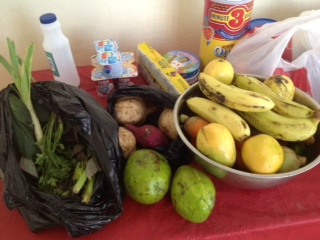
An over abundance of fresh produce.
1.  After 5 days of not eating fruits and veggies go ahead and ask a Haitian to buy them for you.
2.  Then ask the person to not buy so many perishable fruits at once.
3.  Don’t try to eat all the fruit in a couple days just to keep it from going bad.
4.  Haitian matches burn rapidly – be quick with lighting the burners.
5.  Don’t forget to flip on the propane tank switch before lighting the match to light the burner.
6.  When asking for matches in the grocery store by trying to describe in broken Creole what they’re used for, don’t be surprised if the clerk instead gives you bacon.
7.  Set the legs of a table in bowls of water to keep ants off it, and store all your food there.
8.  Put unused avocado in the fridge rather than this table to keep your cat from getting it.
9.  Crack eggs into individual containers so you don’t get a bad one ruining the food you are preparing.
10.  When making hot chocolate, first dissolve the powdered milk in (safe) cold (= room temp) water rather than dumping it into the boiling water where it just clumps up. 
11.  Serious safety tip – rinse all dishes and fruits and veggies in chlorinated water.
12.  Then saute and boil the heck out of your veggies to make sure they're safe to eat.
Discovering why one ant-proofing water bowl kept drying up faster than the others.

Bongu powdered milk, Haitian Rebo coffee, oatmeal, and tropical almonds.
Ramen noodles in sauteed onion and green pepper, with boiled carrots and potatoes.
 

Sunday, September 16, 2012

Restaurants in Les Cayes and Haiti's southern peninsula

Here I'll keep track of the restaurants I've eaten in on the southern peninsula.  I'll focus on the vegetarian options since that's what I eat.  Feel free to post your own reviews in the comments.

In general, restaurants don't have about 1/2 of what is on the menu, and it may take 2 hours before the meals are served since they don't make it until you order.  Many allow you to order ahead.  And they serve HUGE portions!  I haven't learned yet how to convey small portions.  Juices are freshly made and GREAT!  Passionfruit, grapefruit, key lime, orange, cherry...

Les Cayes
Meridien - On Route 2 about a block west of the main gate.  Also a hotel
They don't have the pizza on their menu.  Service was relatively fast, we had our dinner within an hour.  I had the bannan pese (fried plaintains) with rice and something else that I forget, maybe pikliz (spice coleslaw).  With the bannan as my starch I didn't need the rice.  I think everyone else at the table enjoyed their fish.  Not too expensive, $8 I think.

Nami - Chinese restaurant, downtown Cayes.  Great vegetarian eggrolls, and cashew vegetables.  Order ahead!

Ashley and her cheese burger.
Fast and Tasty - Downtown.  I had the Accra (fried taro root, 50gd) and pikliz.  The beet salad is good too.  Also has burgers and pizza.
Scott enjoying his food.
The gas station near the Les Cayes gate is said to have excellent pizza.  Later someone else said it was frozen DeGiorno pizza.  Still sounds good to me.  

William with lambi (conch) and beat salad.


Pikliz and Accra - fried taro root


Torbeck
Lobby of  Chateau Champvert
Chateau Champvert  - On Route 2, look for the sign on the north side of the road and follow the dirt road to it (it's only a block or two back).  This is a very fancy hotel with a swimming pool, gift shop, massage parlor, exercise room, disco lounge, bar, and restaurant.  The food took over 2 hours to arrive.  They gave us some bread as an appetizer, and I finally broke down and asked for our juice before our meal.  See the picture of the vegetarian meal they concocted for me.  Canned peas ringed by
an excellent potato salad ringed by canned corn.  With rice, french fries, pikliz, and bannan pese.  WAY too much food.
The vegetarian option at Hotel La Foi
Chateau Champvert
Again, didn't need the rice, or the canned veggies!  We took the leftovers home.  Rhoda made a soup from her leftover chicken.  About $10.


Port Salut
Hotel Reposoir du Village - On the south side of Route 2, right on the beach.  This place had the best ambiance.  The food took no more than an hour, playing cards and exploring the beach kept us busy.  Had a giant plate of pikliz with rice, and juice.  This was the most expensive place so far - $15.  See pictures here.

Les Anglais 
Hotel La Foi - This was the best and least expensive!  They made a meatless curry-like legume dish - cabbage, carrots, and potatoes.  Also served us bannan pese, beans and rice, and goat.  I had a Malta to drink.  Cost 250gd, or $6, each.  (A member of the group is also the owner's son-in-law, so maybe that was the reason for the price.  It was well worth more than the price).  Also, this would be a great place to stay overnight to go see the mangroves and beaches at the western tip of the peninsula.  Les Anglais also has a rich history of settlement by England.

Obama at Hotel La Foi

Hotel La Foi

Hotel La Foi


Friday, May 11, 2012

Fruit ladies

Black Border 5x7 folded card
Shutterfly offers exclusive graduation announcements and invitations.
View the entire collection of cards.
This is one of my favorite photos.  And I get a $10 coupon for posting it!

Tuesday, March 6, 2012

Navigating the airports - Part III - the Snack Bars upstairs

This is the final post about the airport in Port-au-Prince. Here's what you’ll find in the American Airlines waiting area at the airport (after the final security screen). You can grab a seat and wait, but you should really go upstairs to check out the snack bars. I’ve only eaten at the Rebo one and it’s very good. Mocha for $2.50, and other hot and cold coffee drinks. I get the three-cheese sandwich for $2.50. Order, pay, sit down at a table, and they’ll bring it to you. They grill the sandwiches on a little electric grill. They sell Rebo products – coffee, peanut butter, vanilla, and sell CDs too, including folk songs and more traditional music you can’t find in the gift shops. I suspect the Rebo products are cheaper than in the shops. The Bon Voyage place has French fries, hamburgers, and hotdogs. Another place makes smoothies ($8 I think). And there’s a bar. All sell cold drinks. It’s never been very crowded, and the people are mainly foreigners, so you can sit and try to figure out where everyone is from and what they’re doing in Haiti. From the tables you can see the waiting area below and the sign announcing the flight time, so sit back and relax! Bathrooms are at the back of the main waiting area and are very clean!

Saturday, June 18, 2011

Cassava mill & bread

UCI has a cassava mill to encourage local food production, to move away from reliance on the rice imported from the US. The women peel the manioc root with spoons, it’s soaked in water, ground in the mill, pressed to squeeze out water, then ground again. Salt and other things (sugar etc.) can be added to the flour before it is cooked on large metal plates over coals. The best is when coconut is layered in the middle.


Here’s a recipe for the closest I could get to making it at home. Experiment with small batches until you get a feel for how much water to add.

Heat cast iron skillet on high. To ½ c of cassava flour add 1T water, mix with fork until moist but crumbly. If it’s pastey it will be unpleasantly moist in the center. Sprinkle onto skillet in about a 3in diameter, scrape all the crumbles into the center or they will burn, & tap down with tip of spatula (not the flat side of spatula or it’ll stick). It will set up and when underside browns, flip it and tap down again with tip of spatula. It’s done when brown on both sides. Variation – make it thinner, add a pinch of coconut on top, then a second pinch of cassava mixture. By then it’ll be brown underneath so flip it and tap down with spatula.

It’s not nearly as good as when they make it. Post a comment if you have a better recipe!

Monday, April 19, 2010

Charcoal (chabon)

These pictures show charcoal being sold along the road or in the market. Trees are cut and burned in pits along the hillsides to make charcoal for cooking. The little fuel (propane, etc.) that is imported costs too much for most Haitians. Also shown are the Haitian kitchens which are built outside. The larger brick one is at my hosts' house at UCI, they have to prepare a lot of food for missions teams. The 30 family members they took in after the quake made it a busy place!


2012 update - Here are more pictures of baking and cooking methods, all of which use charcoal: Roasting marshmallows over the stove in the UCI missionary compound. Women cooking up a lot of beans and rice in a church kitchen. The bread bakery at the Bohoc market. The new cassava mill and bakery at UCI.

Thursday, February 11, 2010

Great food in Haiti


The food in Haiti is great! Even when we switched to mainly rice and beans to make the food last with all the house guests, we were still having great meals thanks to the regular employees who cook meals for missions teams and JeanJean’s family who took over most of the cooking.

The yellow flower is pigeon pea which people grow in fields. We have it with rice, as seen in the photo with the okra and the fried manioc in the middle. The manioc is a small tree (shrub?) that has a large root that is also ground to a flour to make cassava bread (in photo) which JeanJean buys fresh from the market.

Corn is hung to dry (or to keep it from mice and rats). Not sure if the corn in the photo is for chickens or people. JeanJean made popcorn for us a couple nights. Cabbages are plentiful and the photo shows them stored in the kitchen, along with a couple breadfruit that is served fried. The cooks also make fried plantains (bannann preze), and we had boiled plantain served with a red sauce (see photo).

We had real milk one morning! Because most people have no refrigeration, milk is heated to sterilize it and then drank while it’s still hot. The rest of the time we use powdered milk. Real cheese is not available, so it makes a great gift for missionaries (freeze a couple cheese blocks and put in your luggage). The only cheese that can be found here is Laughing Cow or equivalent (again, doesn’t need refrigerated).

The little boy is holding a live crab. Don’t know where it came from. The cooks occasionally cooked chicken before the earthquake, but I don’t remember it being served afterwards, though beef was served once. It’s easy to be a vegetarian here. We have eggs for breakfast quite a bit. The chickens run free and scramble up the trees to roost in the evenings.

I took down fixings for s’mores which made for a fun evening.