Monday, October 31, 2016

Educator Academy Part 3 - Canopy Walkway, Explorama, and Ceiba Tops Lodges

ACTS Canopy Walkway
I never got around to a post of these lodges, so here are some photos.  The ACTS field station lodge is the smallest and most rustic of the ExplorNapo Lodges, but they fed us well and had showers.  It mainly serves education and science groups doing work from the ACTS Canopy Walkway.  After that we stayed at the Explorama lodge which had indoor plumbing, electricity, a bar, and small gift shop.  There, people from the local village demonstrate traditional crafts and ways of living, and we bartered for handicrafts (bring t-shirts, all they wanted was t-shirts! The fishing lures did not go over as well as I had hoped).  Our final lodge, Ceiba Tops, is for those who want to experience the Amazon but still have A/C, indoor plumbing, and a pool.  It gave us a chance to clean up before flying out of Iquitos.


Yagua trading booths at Explorama.
Explorama bar and gift shop
Yagua trading booths at Explorama.

ACTS lodge

Ceiba Tops dining hall and restaurant.

Amazed to have electricity and hot showers!

Thursday, August 11, 2016

Educator Academy Part 2 - ExplorNapo Lodge

This post continues the previous, leaving Iquitos Peru on a boat ride up the Amazon River and arriving at the ExplorNapo Lodge.  Our first night at ExplorNapo consisted of orientation to the lodge and Educator Academy program, introductions, dinner, and a night boat ride.  I opted out of the boat ride so I could get up bright and early at 5:30am the next day for the first of many morning birding excursions by boat.  With very knowledgeable guides Luis and Lucio, and returning birders Phil and Dave, we saw over 150 bird species in just 8 mornings of birding (1.5 hours each).  And also saw the pink Amazon River dolphins!  And sloths!  Each night we took either a boat ride or forest walk to see caiman, sleeping hummingbirds, bats, bioluminescent fungi, and the Southern Cross (for the first time). 

Our days were packed with lessons and discussions about the forest and hands-on activities.  This gave me many ideas of what I can do with both the Haitian university and elementary students, such as having students interpret tables to make graphs of biodiversity, explore one-meter square areas of forest floor, and look for birds with Cornell’s BirdSleuth kits (if anyone would like to help me purchase supplies, you can donate at my Global Scholars account).


The Explorama series of lodges are very well maintained and serve great food.  All have large dining halls where we had our classes (with water, coffee, and tea available all the time).  These first three nights we stayed at ExplorNapo Lodge.  To reach our dorms from the dock and dining hall we had to cross a bridge over the flooded forest!  Talk about immersion into your studies.  While there was electricity in the dining hall, kerosene lanterns lit the bedrooms and walkways.  The latrines were huge!  And showers cold, so I adopted my Haiti routine of showering and laying out my evening things during the afternoon while there was light and a cold shower felt good.  We were in the Amazon during Peru’s dry winter season, so temperatures stayed around 75F.  Which meant I used a blanket at night.  But humidity was so high that you work up quite a drenching sweat just walking through the forest during the day.  Many visitors staying at the more upscale CeibaTops Lodge (electricity and hot showers) stopped at ExplorNapo for lunch on their way to the ACTS Canopy Walk – subject of the next post!

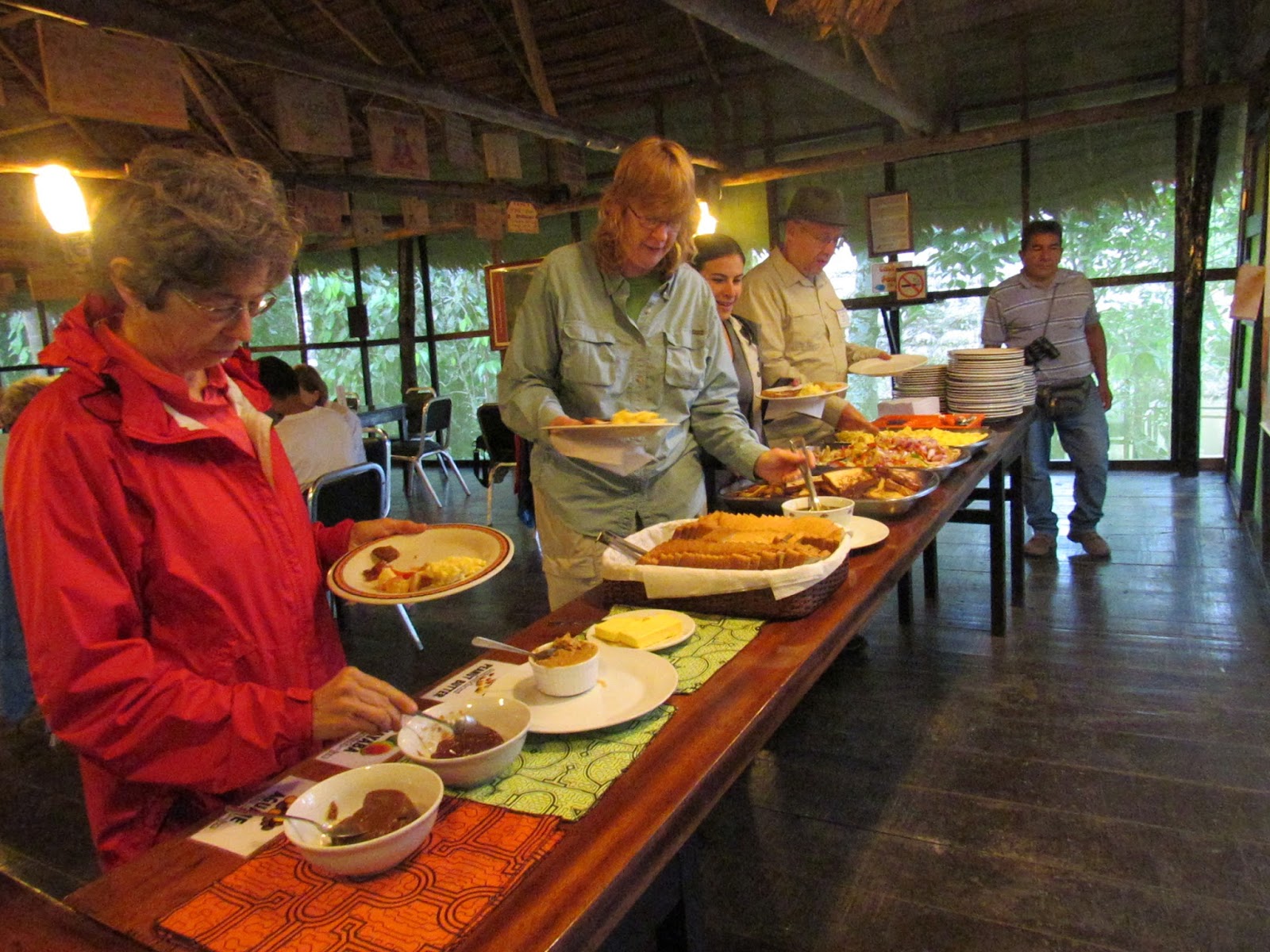
Breakfast!!
Giant latrine!  With nice walls.
Walkway in front of the rooms.
Mosquito nets over the beds.  Open windows and thatched roof!


Saturday, August 6, 2016

Tropical Ecology Class for Teachers – Educator Academy Part 1

Flight to Iquitos over Amazon forest & rivers.
I teach tropical ecology classes at UCCC in Haiti, and was fortunate to take a tropical ecology class of my own this summer!  In the Amazon!  I wanted to see in person what it is that I teach my class: the physical structure of the rain forest, the shallow organic layer covering the forest floor, the diversity of birds and other wildlife.  However, to reach Haiti’s remnant tropical forests such as those at Peak Macaya requires a day and a half drive, a day’s walk, camping equipment, hiring a guide, etc.  It all seems complicated.  And financially impossible to take my students.  Then I learned about the Educator Academy in the Amazon Rainforest that takes teachers from the US to Peru to not only teach basic tropical ecology, but just as importantly, how to convey that information to students.  And I received a partial scholarship to attend the academy!  

Charcoal in Iquitos (like in Haiti)
The following posts highlight the activities we did at each of the ExploramaLodges that we stayed in during this 10 day excursion.  The lodges are located along the Amazon River and its Napo tributary, accessible only by boat from Iquitos, Peru’s port city on the Amazon (and the largest city in the world accessible only by boat or plane).  Who knew that the Amazon River had ports as large as ocean-side ports?  And that ships travel all the way upstream 2200 miles from the Atlantic Ocean? 


The trip consisted of flying to Lima Peru, meeting up with 30 other teachers and the academy faculty, staying overnight in a hotel connected to the airport, flying to Iquitos on a rather large plane, and landing in a decent-sized regional airport (I was expecting dinky plane and airport like in Haiti).  We loaded onto a bus and stopped at a market on the way to the boat dock.  I couldn’t help comparing everything I saw to Haiti, which made me realize I expected Peru to be less developed, and perhaps indicates how undeveloped (or just chaotic) Haiti really is (the crowds, litter, downed electric lines, open manholes, horrible traffic, etc. has all become normal to me). 

Cat at the Iquitos market
At the dock we boarded two boats for a 2 ½ hour ride ON THE AMAZON RIVER!  To our first lodge – located IN THE AMAZON FOREST!  More to come in the next post.

Tapir and caiman skulls?  

Logging ship on the Amazon River.
Large ships at port on the Amazon River.


Monday, January 25, 2016

Bassin Zim guards and guides

Entrance to Bassin Zim
Feb. 2017 update - they addressed these complaints!  There is now a sign with prices and we entered the park in peace.

Bassin Zim is a waterfall near Hinche in the central plateau.  HaitiLibre had an article about the Ministry of Tourism putting it on their "Water Route" circuit so it will “be part of a model of sustainable development based on community tourism.”  The Ministry met with the locals in Dec. 2015 to discuss “the need for communities to well welcome visitors to the site.”  I write this review to give the Ministry some feedback from a foreigner’s point of view. 

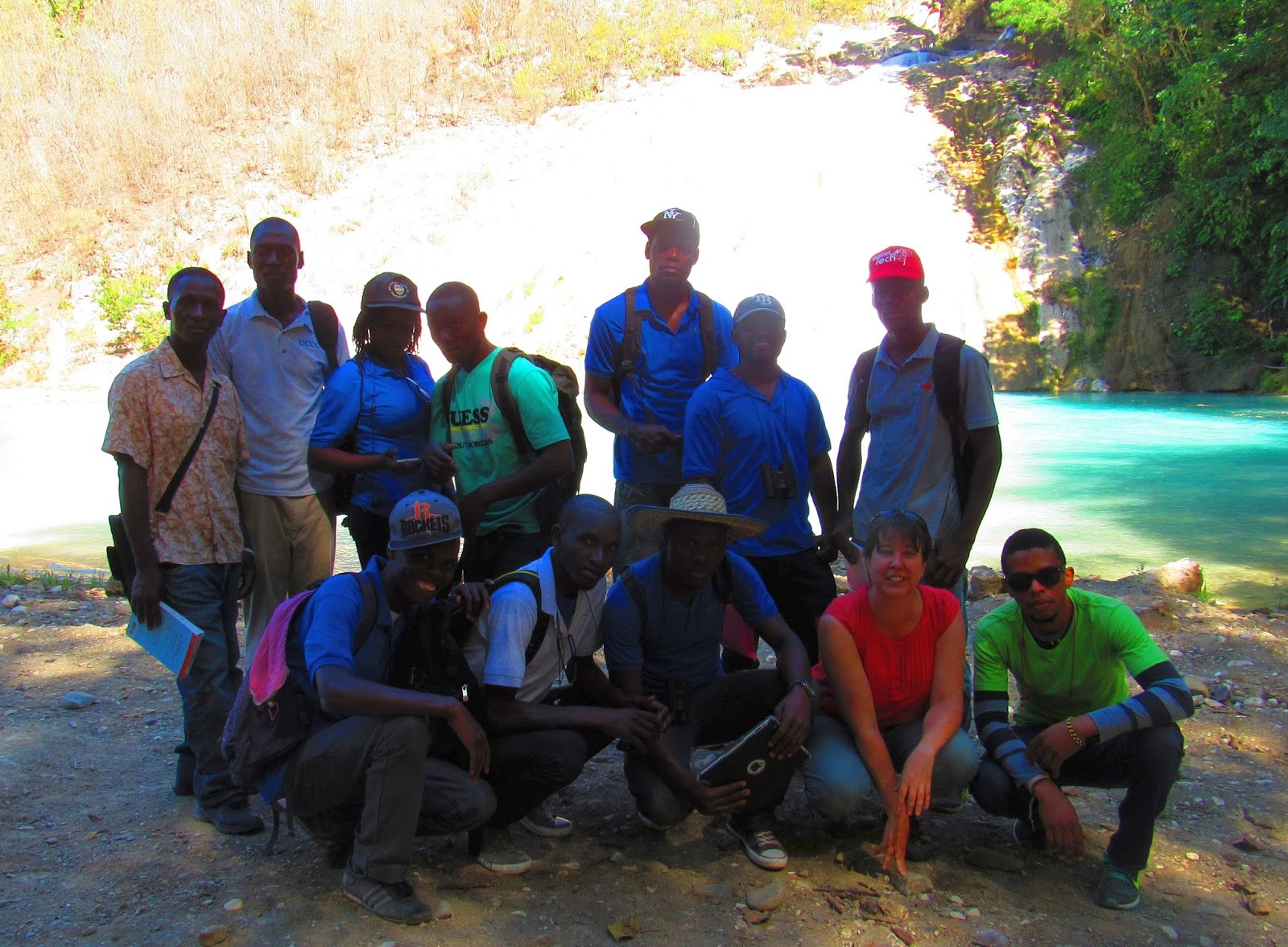
Three times I have taken my Haitian university students to Bassin Zim to learn about water quality, and have not felt welcomed upon arrival.  The 15 minute haggle over entrance fees makes for a poor start to the visit.  It is especially sad that the guards want to charge their fellow Haitians twice as much just because a foreigner is with them.  Negotiations involve telling the guards we were charged 25 gds per person on our first visit, the guards insisting on 50 gds a person then getting mad and yelling.  One time this deteriorated into them hitting children with sticks and large rocks, making the kids cry.  While the kids had disrespectfully yelled at the guards to let us in, the violent reproach left a very bad impression.  

Last week my freshman ecology class negotiated a price of 250 gds ($4) for the entire van of 19 people.  As we left we thanked the guards and said we’d return with another class.  Yet on arrival just one week later with my juniors, the same guards again demanded 50 gds a person.  After much haggling and the guard feigning locking gate and stomping off, my junior ecology students managed to get us in for 250 gds, this time for a van of 13.  Each time my students were respectful, and even broke up the fight between the guards and the children.

Measuring turbidity.
During last week’s visit with my freshmen, five “guides” (both children and adults) followed us around and insisted on “helping” me (but not my students), even though my students explained we had a plan and knew where we were going.  This week the children figured out we had an agenda and hung out in the background.  A student gave them a little lesson about testing water chemistry and evaluating the watershed.  If the Ministry of Tourism really wants to promote Bassin Zim, it needs to standardize and post entrance fees (with reduced rates for locals), and train guards and guides to be courteous to visitors (both Haitian and foreign). 

If they truly care about the water and sustainability, they need pick up trash, ban livestock and washing in the river, protect the remaining trees (charcoal was being made right along the path to the cave), put a buffer of more trees around the park (crops grow right up to the walkway), and remove the new tilapia pond that sits next to the cave and dumps directly into the river.  Maybe someday one of my students will work for the Ministry of Tourism or the Environment and enact these changes.


The big cave

Small cave
Teaching about water quality next to the tilapia pond.

Measuring temperature.
Measuring forest density.


Sunday, December 20, 2015

La Fouchet restaurant Port au Prince Haiti

Magda with shrimp and fried plantains.
American friends of mine in Haiti occasionally talk about the ‘Embassy restaurant that has sushi.’  I finally got to go there, and was surprised at how close it is to the house I stay in when I fly in and out of Haiti.  Apparently the residents go there often, but had never mentioned it to me!  La Fouchet is located on Blvd. 15 Octobre, Tabarre 43, near the US Embassy and the large MSC construction store.  It is on the property of a hotel/apartment complex called Executive Villas.  Park and follow the sign back to the restaurant.  Seating is open air under a roof and by the pool.  The vegetarian Caterpillar Rolls were excellent (California roll with avocado, cream cheese, and tempura onion).  I also had passion fruit juice and flan for dessert.  My friend had a shrimp dish with fried plantain and ice cream.  They also have breakfast, steak, burgers, pizza, pasta, and some Mediterranean dishes (for the Jordanian UN?).  Prices were reasonable for a nice meal.  Service was fast for Haiti!  I would definitely go back, especially after almost 2 months of rice and beans.  
Look for the entrance on the corner.

Walk past the little apartments or hotel rooms.

Caterpillar roll and passion fruit juice with pool-side seating.
Flan

Sushi and dessert menu
The restaurant
Pool rules - what is the one above the wine glass?

Monday, December 7, 2015

Birding with the cave children

Antillean Mango posing for the kids.
Last year I taught in a small village that sits away from any roads and is a 20 minute walk from my house.  I don’t know if any foreigners pass through except to go to a nearby cave.  I forget how we fell into teaching in the yard of Goyo, the man who owns the cave (JeanJean always mentions that he owns some of the cave too!), but last year Louiders and I went to his house weekly to give one hour-long ecology lessons to the kids.  We recently began lessons again, and I decided to do something that seemed likely to be chaotic – take the random assortment of 30 kids, aged 2 to 18(?) years old, birding!  We had been taking the orderly elementary school classes at UCC out birding, so had some practice (see this post).  Birding at three in the afternoon also seemed risky, but we tried it anyway with great success.  The children shared the seven binoculars (thanks to everyone who donated them!).  We didn’t see many birds, but a hummingbird hung out with us long enough for us to see its curved beak indicating it was an Antillean mango, and black stripe indicating it was an immature male.  These pictures show the kids having fun!
Showing the little one how to use binoculars. The 2-holer in the background is what you think it is!


Stripe showing that this is a young male Antillean Mango.


Tuesday, November 24, 2015

Team Work

Teaching in the university here in Haiti has given me a chance to see the American church and medical teams that come to UCI.  In just 3 weeks I have seen 5 teams!  They ranged from an Iowa family of 5 with kids aged 8 to 12, to a California church team of 27 that included doctors, teens, school teachers, and a carpenter.  And as a special bonus a friend from Kansas was on a team!  Here are some pictures showing the range of things people can do here in Caiman and the surrounding community.  JeanJean and Kristie make sure the teams are going where they are most needed.  I’ve tagged along with the groups so that I could teach bats and birds to kids while the teams worked.  

On Sundays the teams make lunch so the cooks can have the day off.  Kansas Nate with the Nebraska team cooks.

The small CA team provided a cement floor to help the family avoid health problems caused by dirt floors.

I taught ecology while the team helped with the cement floor.

The Nebraska team performed a skit for kids.

The Men's Choir entertained the teams.

Dr. LeeAnn in a remote medical clinic.

Deanna and Tricia organized medical supplies in the new clinic at the UCI university.